
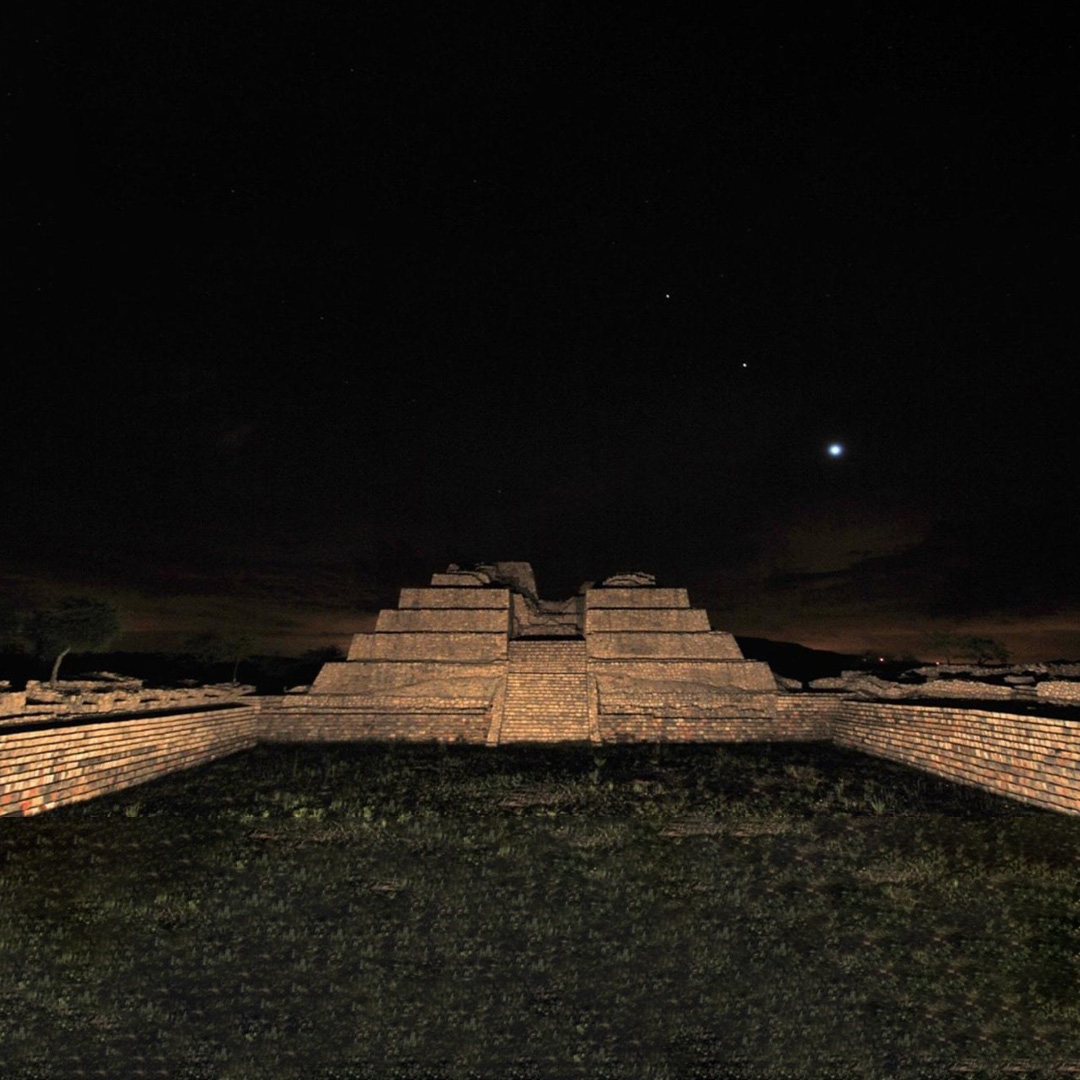
It is one of the most important settlements in the northern region of Mesoamerica. It was occupied during the Epiclassic period (between 450 and 1050 AD), after which it was abandoned, like other sites in the area. Cañada de la Virgen is a settlement of considerable size with a significant number of structures.
It is a notable site because its main monuments were used for astronomical observations. The site is composed of five complexes, all sharing the same orientation associated with the movement of the Sun and the Moon. In addition, its urban layout is arranged according to cosmic cycles. On the surrounding hills, toward the four cardinal directions from the ceremonial center, there are boundary markers aligned with the buildings.
Among the site’s structures, the Civic-Ceremonial Center stands out as the most important, featuring a water reservoir that likely played a key role in the founding of the city. Other notable structures include the House of the Thirteen Heavens (Complex A), the Sunken Patio, the main public and ceremonial space of the site, and the Pyramid Platform. It also has an interesting museum displaying artifacts recovered from the site.